
Chronic Pain Management
  • Home
  • All Courses
  • Chronic Pain Management Guide

Chronic Pain Management Guide

Curriculum

  • 4 Sections
  • 54 Lessons
  • Lifetime
Expand all sectionsCollapse all sections
  • Overview
    Overview
    1
    • 1.1
      Overview
  • The Chronic Pain Management Guide
    Chronic Pain Management Guide
    11
    • 2.1
      Baseline History Essentials
    • 2.2
      Opioid Risk Tool
    • 2.3
      Physical Examination Essentials
    • 2.4
      Follow-Up Assessment
    • 2.5
      Treatment Essentials
    • 2.6
      Stepped Care Drugs for Nociceptive Pain
    • 2.7
      Stepped Care Drugs for Neuropathic Pain
    • 2.8
      Drugs of Abuse Urine (DAU)
    • 2.9
      Patient Teaching Tools
    • 2.10
      Definitions
    • 2.11
      Other Tools
  • Physical Examination Videos
    Physical Examination Videos
    40
    • 3.1
      Adam’s Forward Bending Test
    • 3.2
      Apley’s Compression Test
    • 3.3
      Carnett’s Test
    • 3.4
      Cervical Range of Motion
    • 3.5
      Cross Arm Test/Scarf Test
    • 3.6
      Empty Can Test
    • 3.7
      Erector Spinae Palpation
    • 3.8
      FABER
    • 3.9
      Femoral Nerve Tension Test
    • 3.10
      Gluteus Medius Palpation
    • 3.11
      Hawkins-Kennedy Test
    • 3.12
      Hornblower’s
    • 3.13
      Infraspinatus Test
    • 3.14
      Integrated Low Back Exam
    • 3.15
      Internal Rotation of the Hip
    • 3.16
      Lachman Test
    • 3.17
      Lhermitte’s Sign
    • 3.18
      Liftoff Test
    • 3.19
      Lumbar Range of Motion
    • 3.20
      McMurray Test
    • 3.21
      Neer Test
    • 3.22
      Noble Compression Test
    • 3.23
      Ober’s Test
    • 3.24
      Patellofemoral Compression Test
    • 3.25
      Pelvic Compression
    • 3.26
      Phalen’s Test
    • 3.27
      Piriformis Test
    • 3.28
      Quadratus Lumborum Palpation
    • 3.29
      Righting Reflexes
    • 3.30
      Sacroiliac (SI) Joint Palpation
    • 3.31
      Seated Slump Test
    • 3.32
      Speed’s Test
    • 3.33
      Spurling’s Test
    • 3.34
      Straight Leg Raise Test
    • 3.35
      Thigh Thrust
    • 3.36
      Tinel’s Sign for Carpal Tunnel Syndrome
    • 3.37
      Tinel’s Test for Cubital Tunnel Syndrome
    • 3.38
      Tinel’s Test for Tarsal Tunnel
    • 3.39
      Upper Extremity Neural Tension Test
    • 3.40
      Yergason’s Test
  • References
    References & Acknowledgements
    2
    • 4.1
      References
    • 4.2
      Acknowledgements

Drugs of Abuse Urine (DAU)

Lab menu: DAU and oxycodone screen
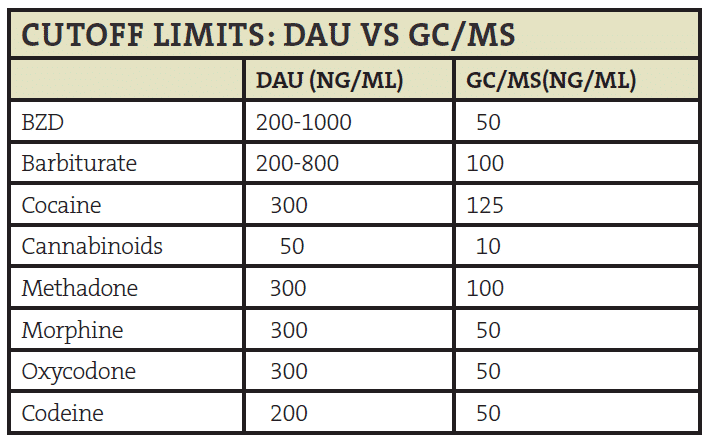
 

+Opiates:Indicates any combination of codeine, MSo4, hydrocodone, hydromorphone, oxycodone.

  • When ordering DAU, add screen for oxycodone, buprenorphine, and fentanyl.
  • Tramadol will not be detected by DAU opiate screen; confirmation required.

DAU tests specifically for cocaine and methadone metabolites benzoylecgonine and EDDP, respectively.

  • Nucynta may produce false positive for methadone.

Detection Period

  • Opiates: 1-2 days for most, 2-3 days for fentanyl
  • Methadone: 3-11 days
  • THC: 3 days single use, 4 days moderate use, 10 days heavy use, 30-36 days for chronic, heavy use
  • Alcohol: 7-12 hours
  • Collection: 50 ml, ward collect.
  • Temperature: 90-100 degrees within four minutes of voiding.
  • Tampering/Dilution: Order creatinine and specific gravity.
  • Urine Creatinine: < 20mg/dl considered dilute.
  • Urine specific gravity (SG): 1.002-1.020, SG H20 = 1.0.
  • Substitution: pH extremely low < 3 or high > 11.
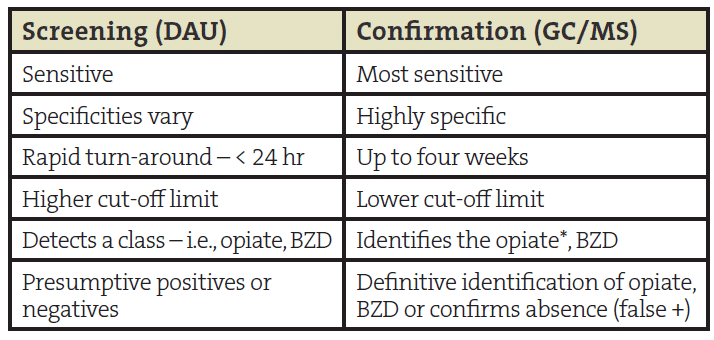
  • Confirmation: GC/MS-confirms DAU result and identifies the drug.
  • To order: Consult, lab consult, DAU confirmation outpt.
  • False positives: To rule out (or in) especially amphetamine, BZD, other unexpected results.
 

Miscellaneous

Heroin: 6-MAM in ~6-8hr, then morphine

  • Only the presence of 6-MAM confirms heroin:
    • + THC with passive exposure highly ulikely;
    • Poppyseed-+morphine, patient counseled to abstain; or next positive will be assumed to be illicit.
    • Low dose or PRN use-may not be + on DAU or confirmation
  • Consider pill counts mid-prescription for actual use:
    • High dose oxycodone expect parent drug and metabolite i.e., oxycodone AND oxymorphone.
    • Absence of oxycodone implies not taken recently, oxymorphone can last 1-2 days after oxycodone.
    • Morphine can also confirm for hydromorphone.
    • Vicodin-hydrocodone or hydrocodone and hydromorphone or hydromorphone alone.

Approach to Opioid Tapering in the Patient without Addiction: BETTa

  • Identify all Biopsychosocial treatment targets.
  • Educate patient about pain contributors and benefits of opioid tapering.
  • Treat all targets using an evidence-based, collaborative approach.
  • Taper opioids very slowly – <10% of total daily dose every 1-2 months for those on chronic treatment.
Stepped Care Drugs for Neuropathic Pain
Prev
Patient Teaching Tools
Next

Archives

No archives to show.

Categories

  • No categories
Copyright © 2024 Department of Medicine / University of Pittsburgh School of Medicine / All Rights Reserved Site maintained by the Department of Medicine | Email