
Chronic Pain Management
  • Home
  • All Courses
  • Chronic Pain Management Guide

Chronic Pain Management Guide

Curriculum

  • 4 Sections
  • 54 Lessons
  • Lifetime
Expand all sectionsCollapse all sections
  • Overview
    Overview
    1
    • 1.1
      Overview
  • The Chronic Pain Management Guide
    Chronic Pain Management Guide
    11
    • 2.1
      Baseline History Essentials
    • 2.2
      Opioid Risk Tool
    • 2.3
      Physical Examination Essentials
    • 2.4
      Follow-Up Assessment
    • 2.5
      Treatment Essentials
    • 2.6
      Stepped Care Drugs for Nociceptive Pain
    • 2.7
      Stepped Care Drugs for Neuropathic Pain
    • 2.8
      Drugs of Abuse Urine (DAU)
    • 2.9
      Patient Teaching Tools
    • 2.10
      Definitions
    • 2.11
      Other Tools
  • Physical Examination Videos
    Physical Examination Videos
    40
    • 3.1
      Adam’s Forward Bending Test
    • 3.2
      Apley’s Compression Test
    • 3.3
      Carnett’s Test
    • 3.4
      Cervical Range of Motion
    • 3.5
      Cross Arm Test/Scarf Test
    • 3.6
      Empty Can Test
    • 3.7
      Erector Spinae Palpation
    • 3.8
      FABER
    • 3.9
      Femoral Nerve Tension Test
    • 3.10
      Gluteus Medius Palpation
    • 3.11
      Hawkins-Kennedy Test
    • 3.12
      Hornblower’s
    • 3.13
      Infraspinatus Test
    • 3.14
      Integrated Low Back Exam
    • 3.15
      Internal Rotation of the Hip
    • 3.16
      Lachman Test
    • 3.17
      Lhermitte’s Sign
    • 3.18
      Liftoff Test
    • 3.19
      Lumbar Range of Motion
    • 3.20
      McMurray Test
    • 3.21
      Neer Test
    • 3.22
      Noble Compression Test
    • 3.23
      Ober’s Test
    • 3.24
      Patellofemoral Compression Test
    • 3.25
      Pelvic Compression
    • 3.26
      Phalen’s Test
    • 3.27
      Piriformis Test
    • 3.28
      Quadratus Lumborum Palpation
    • 3.29
      Righting Reflexes
    • 3.30
      Sacroiliac (SI) Joint Palpation
    • 3.31
      Seated Slump Test
    • 3.32
      Speed’s Test
    • 3.33
      Spurling’s Test
    • 3.34
      Straight Leg Raise Test
    • 3.35
      Thigh Thrust
    • 3.36
      Tinel’s Sign for Carpal Tunnel Syndrome
    • 3.37
      Tinel’s Test for Cubital Tunnel Syndrome
    • 3.38
      Tinel’s Test for Tarsal Tunnel
    • 3.39
      Upper Extremity Neural Tension Test
    • 3.40
      Yergason’s Test
  • References
    References & Acknowledgements
    2
    • 4.1
      References
    • 4.2
      Acknowledgements

Patient Teaching Tools
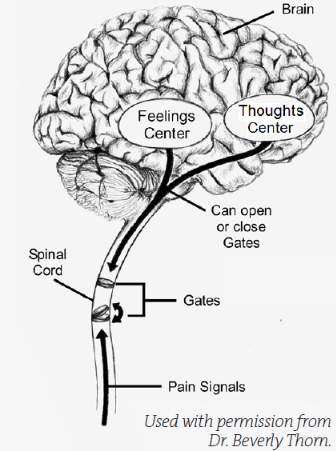
Pain and the Brain

There is a neurological gate in the spinal cord through which pain travels from the body to the brain. This gate can be opened or closed by signals from the brain. Some positive signals from the brain that close the gate are physical activity and distraction by positive emotions. Some negative signals that open the gate are depression and catastrophic thoughts.


The Goal of Pain Management

Patients with chronic pain may feel that pain controls them (i.e., “Your pain has you.”). The goal of chronic pain treatment is to change this perception (i.e.,“You have your pain.”) Remember, the main goal is to REDUCE PAIN INTERFERENCE, not to eliminate pain.
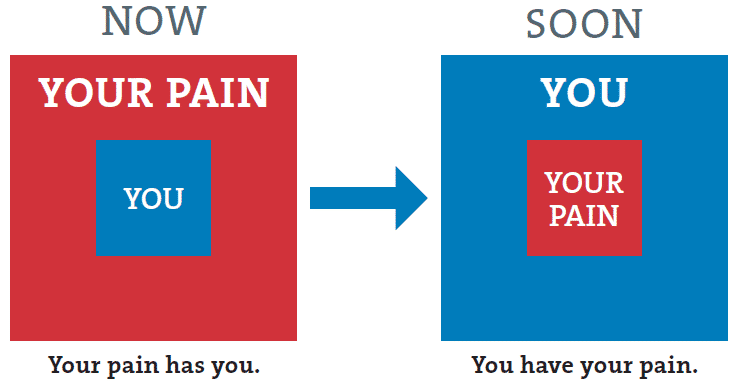
Now – Your pain has you. Soon – You have your pain.

Drugs of Abuse Urine (DAU)
Prev
Definitions
Next

Archives

No archives to show.

Categories

  • No categories
Copyright © 2024 Department of Medicine / University of Pittsburgh School of Medicine / All Rights Reserved Site maintained by the Department of Medicine | Email