
Physical Examination Essentials
Common Pain Sites/How to Focus the Exam
Always perform a routine physical examination of the region in question; in addition, evaluate for regional myofascial pain and perform the other maneuvers listed:
By Region
- Abdominal Pain: Evaluate for abdominal wall (myofascial) pain using Carnett’s test.
- Arm (upper):
- Neck
- Shoulder (see shoulder exam, page 7)
- Rotator cuff
- Buttocks/Groin:
- Hip internal rotation
- SI joint (FABER’s test, palpate SIJ, Thigh thrust, Pelvic compression in side-lying)
- Knee:
- 1. Observe alignment and for effusion
- 2. AROM vs. PROM (hip and knee)
- 3. Palpation (joint line, tendons, Pes anserine bursa)
- 4. Provocative testing:
- a. McMurray (meniscus)
- b. Apley’s compression/Lachman (instability)
- c. Patellar compression (Patellofemoral Syndrome)
- d. Noble (IT band)
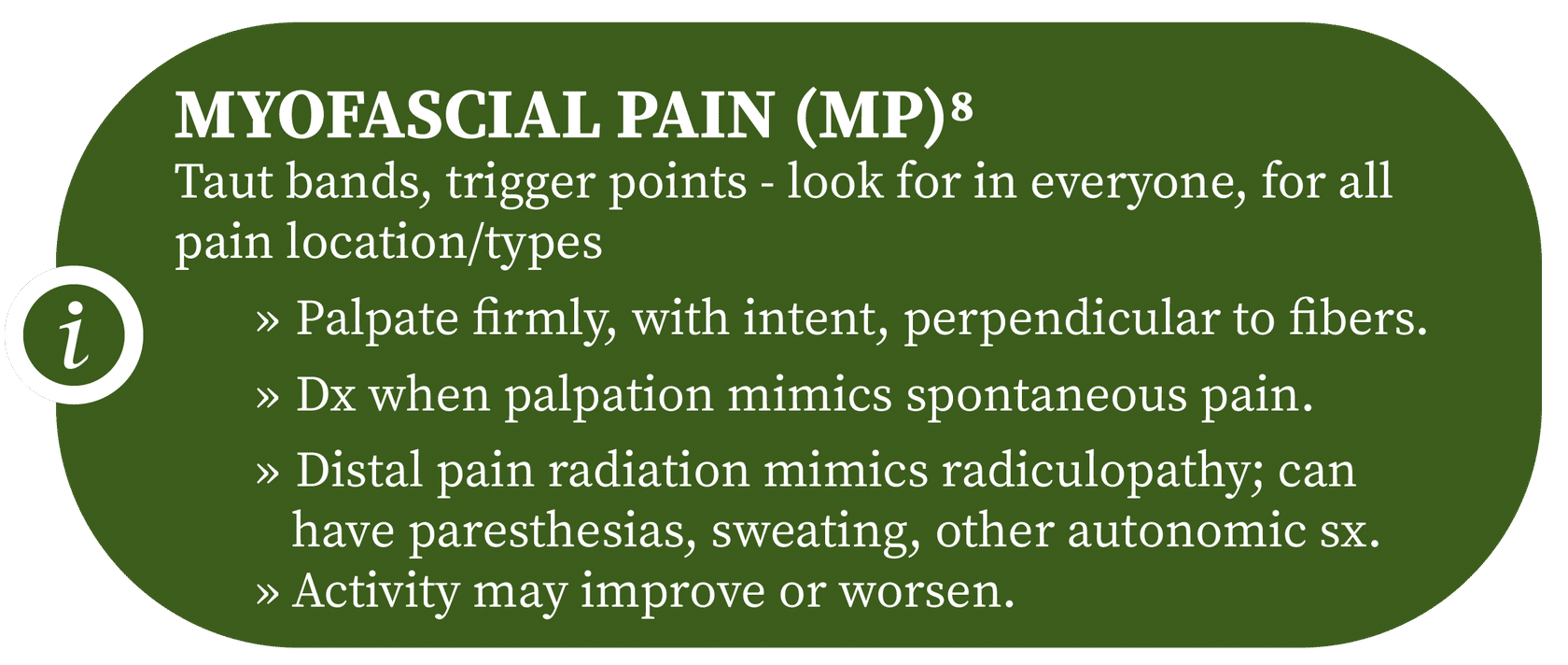
- Low Back: Lumbar range of motion, hip internal rotation, knee exam, SI joint (FABER’s test, palpate SIJ, thigh thrust, pelvic compression in side-lying), leg length discrepancy, spinal alignment (scoliosis [palpation, Adam’s Forward Bend], kyphosis); quadratus lumborum/erector spinae (iliocostalis lumborum)/gluteus medius myofascial pain
- Neck/Upper Back: Range of motion of neck, shoulder (see shoulder exam, page 12); if concerns for multiple sclerosis, check Lhermitte’s sign.
- Sciatica: Straight leg raise, piriformis exam (piriformis syndrome)
- Shoulder: Active ROM (Apley’s scratch test) vs. Passive ROM
- 1. Rotator cuff muscle strength testing with resistance:
- a. Supraspinatus – empty can
- a. Infraspinatus – external rotation
- b. Subscapularis – lift off
- c. Teres minor – Hornblower’s
- a. Supraspinatus – empty can
- 2. Impingement – Neer sign and Hawkins-Kennedy test
- 3. Biceps – Speed’s and Yergason’s
- 4. Acromioclavicular – cross arm test
- 1. Rotator cuff muscle strength testing with resistance:
- Thigh: Hip internal rotation, IT band (lateral pain) – Ober’s test, direct palpation, SI joint (FABER’s testpalpate SIJ, thigh thrust, pelvic compression in side-lying), Lumbar spine (dermatomes); if pain – paresthesias and diminished sensation of anterolateral thigh, consider meralgia paresthetica (lateral femoral cutaneous nerve entrapment)
Neuropathic Pain Symptoms: Focusing the Evaluation
By Problem
- Bilateral symptoms (e.g., paresthesias, dysesthesias) with distal +/- proximal extremity involvement: R/O toxic/metabolic causes (e.g., DM, heavy metal poisoning), hereditary (e.g., Charcot-Marie-Tooth), malignancy
- Unilateral or bilateral symptoms: Compression mononeuropathy (check Tinel’s at carpal tunnel, and/or Phalen’s for median nerve symptoms; check Tinel’s at cubital tunnel if ulnar neuropathy symptoms; check Tinel’s at tarsal tunnel if tibial neuropathy symptoms)
- Radiculopathy symptoms: Check Spurling’s and/or upper extremity neural tension test for upper extremity symptoms, seated slump test for lower extremity symptoms, femoral nerve tension test if anterior thigh symptoms.
Older Adults: Essential Supplemental Exams
- Mobility/Balance: Observe gait, righting reflexes (i.e., ability to right self in response to backward tug of pelvis)
- Cognitive Function: Mini-cog (3-word recall with clock draw as distractor)9
- 0/3 recall: Dementia very likely.
- 1-2/3 recall + normal clock: Dementia less likely.
- 1-2/3 recall + abnormal clock: Dementia possible.
- 3/3 recall: Dementia very unlikely.